Tuesday, July 1, 2014

Turin Italy


Castle Square is the main plaza in Turin and is the location of many municipal structures. This was the location of a Roman Gate around 100 BC and has been a site of monumental architecture ever since. Today the square has the Palazzo Madama e Casaforte degli Acaja which was the palace to two queens (earning the name Palazzo Madama). It also has the remnants of a castle which (depending on the website) suggests an origin in the AD 1200s and was at least altered in AD 1500s if not rebuilt at that time. The square was designed by Ascanio Vitozzi in AD 1564 and also has the Royal Palace (which houses the Shroud of Turin in the Chapel of the Holy Shroud) and the Royal Library (which houses Leonardo da Vinci's operas). In the picture above the Palazzo Madama is in the center of the photo and the Royal Palace is in the distance on the left.


It was interesting that the City of Turin had erected a monument to General Emanuele Filiberto Duca D'Aosta in the Pizza Castello that commemorates his deeds in World War I directly in front of the castle so now this more modern monument dominates the front of the castle. This layering of historical structures and monuments is present throughout Europe with its long history. It seems that their juxtaposition results in a different meaning and feel than a monument standing on its own. We also found this in Edinburgh (see later post) with a 1900s war monument dominating the central court of Edinburgh Castle.


The Mole Antonelliana was designed by architect Alessandro Antonelli and was completed in 1889.  It was designed to be a mosque but houses the Museo Nazionale del Cinema today. Apparently a Mole is a building of monumental proportions and this is actually the tallest museum in the world. This structure dominated the south side of Turin’s skyline and really drew your attention as you walk through that part of the city.


The Monumento Nazionale al Carabiniere (National Monument to the policeman) was designed by Edoardo Rubino to commemorate the sacrifices of policemen during World War I and is standing in the garden of the Royal Palace of Turin. The monument was commemorated in 1933 in the presence of the King. During World War II, this monument was severely damaged, but was repaired and reopened in 1948.


The Po River runs through Turin and has contributed to its economic and strategic importance through history. Across the Vittorio Emanuele I bridge is the church of Gran Madre di Dio which was proposed in AD 1814.  The architect was Ferdinando Bonsignore who designed the church in a Neoclassic-style and it was completed in 1831. On top of the hill in the distance is the late-Renaissance style church called Santa Maria di Monte dei Cappuccini which was built for the Capuchin Order of the Catholic Church which is an offshoot of the Franciscan Monks. The Capuchin Order arose in AD 1520 and Friar Matteo obtained the approval of Pope Clement VII in 1528 to live as a hermit and to preach to the poor. Ascanio Vitozzi (who designed Castle Plazza) designed the church and started its construction in AD 1583, but it was not completed until AD 1656 by the engineer Giacomo Soldati.


Turin has many squares (or Piazzas) which are used for gatherings and ceremonies. Piazza San Carlo has the nickname “living room of Turin” and is thought to be one of the main gathering places in Turin. It has long been a center for political life in the city and the surrounding area with many meetings occurring in the cafes that line the sides of the square with seating that extends into the square. The twin Baroque churches at the far end of the square are the church of San Carlo which was built in AD 1619 and the church of Santa Christina which was built in AD 1639. The monument of the horse rider in the middle of the square is to Emanuele Filiberto who brought the Holy Shroud to Turin in AD 1578. This monument was sculpted by Carlo Marocchetti in AD 1838 and is one of the symbols of the city of Turin.


I really enjoyed my time in Turin. Besides my visit to the Dendrochronology Laboratory at the University (see a later post), I got to take a tour of the Western Italian Alps with Renzo Motta (see a later post) and spent a great evening in the city with him and his students. I got to experience Grom Gelato which Renzo said was the best in Italy (and I can agree based on my limited experience).

Thursday, June 26, 2014

Pavia Italy


Dr. Renzo Motta arranged for me to visit northern Italy for a week to tour the University of Turin and the University of Padua. Renzo, Dr. Daniele Castagneri, Dr. Giai Petit, Dr. Marco Carrer, and Dr. Paola Nola were excellent hosts and I got to see five cities, the western Italian Alps, the eastern Italian Alps, and spend a night in Venice.
 
My flight to Milan connected through the Rome airport. I got to see some interesting landscapes including the coastal town of Fiumicino where the Leonardo da Vinci airport is located on the outskirts of Rome. According to Wikipedia, this is the sixth busiest airport in Europe.


To the south of Rome are a series of old calderas that are now filled with rainwater. From the air, Lago Albano, Lago di Nemi, and the surrounding Parco Regionale dei Castelli Romani look like a beautiful natural area that I would like to visit in the future. We had a very nice view of these mountains and lakes as we flew into the Leonardo da Vinci airport outside of Rome. Reading about this area on Wikipedia showed that this was the site of the 1960 Summer Olympic canoeing competition, the site of Castel Gandolfo which is a retreat that the popes would visit, and it also showed this 1869 painting by George Inness. I like these old paintings as a representation of what the landscape and vegetation looked like over 100 years ago.

Georges Inness 1869 (photo from Wikipedia http://en.wikipedia.org/wiki/George_Inness)

I landed in Milan and Renzo picked me up at the airport. We quickly drove to the town of Pavia which was 22 miles south of Milan where I stayed the night and had a wonderful Italian meal with Renzo and his family. They gave me a great tour of the city that included viewing some of the old churches, the University of Pavia campus, and the river that runs through the town. I really like these old city streets with buildings from the 16th century lining the cobble stone streets.


This area of Italy is flat, being located between the Italian Alps to the north and the Apennines to the south. It is a large agricultural region that actually produces a lot of rice. You can see the reflection of the light off of the rice paddies as we flew into Milan. The Po River Valley is a major geologic feature which is a low-lying area that has been in filled with the sediment from the Apennines (orogeny – mountain building – peaking from 23.0-2.6 million years before present) and the Alps (caused by the collision of the African and European plates starting in the Late Cretaceous about 70 million years ago and peaking about 35 million years ago).


Publius Cornelius Scipio, a consul with the Roman Empire, established a military camp in 218 BC at the site of modern day Pavia and the city has played an important role in history ever since. The Roman bridge over the river was completely replaced in AD 1354. This bridge was badly damaged during World War II. During the debate on whether to repair or replace that bridge, a large section of it collapses in 1947 so it was decided to replace the bridge with this modern construction.


The University of Pavia was founded in 1361 and located at the site of the school or rhetoric which is documented to have existed in AD 825. This would make this the oldest proto-university in Europe. It is amazing to visit places with such long and storied history compared to our young European architecture and history in the United States.


Many notable scientists, philosophers, and artists have resided at the University. Alessandro Volta (1745–1827) is probably one of the most notable scientists that I recognized from studying physics as he is the inventor of the battery. I wish I had more time to tour the University and read about the history that has transpired in this place. Since I am following Albert Einstein around Europe, I feel that I should mention that he lived in Pavia from 1894-1895 with his family when he was 15 years old.


It was good to meet Dr. Paola Nola and spend an evening with her family touring the city. She is an associate professor at the University of Pavia who focuses on botany, ecology, and dendrochronology. Much of her work is related to developing chronologies in multiple species in the Quercus, Fagus, Larix, and Pinus genera as well as examining climatic response (Nola 1996) and ecological interactions such as her paper examining the interaction between Fagus sylvatica and English ivy (Hedera helix - Nola 1997). She has also completed insect outbreak analysis on Larch budmoth (Zeiraphera diniana) and examined its effect on forest dynamics (Nola et al. 2006).


Cathedral Square shows the common roundabouts, tram tracks, and has a statue of Minerva by sculpture Francesco Messina from the early 1900s.  Minerva was the Roman Goddess of wisdom as well as poetry, medicine, commerce, weaving, crafts, and magic. She was the roman equivalent of the Greek Goddess Athena which was a nice continuation of our experiences in Athens.


The Basilica of San Michele Maggiore was completed in AD 1155. It was built on the site of the Lombard Palace chapel which was destroyed in a fire in AD 1004.  This was also the site of the coronation of Louis III in AD 900 and Frederick Barbarossa in AD 1155.


Construction on the Cathedral of Pavia was started in AD 1488. Leonardo da Vinci was known to have contributed to the construction of this church and one of his students completed the alter area AD 1521. Just outside of this Cathedral was the Civic Tower of Pavia which was built in the 11th century and was 72 meters tall. This tower collapsed on March 17th, 1989 killing four people and injuring 15 others. The tower was partially constructed with brick which decayed overtime resulting in this catastrophic collapse.

I only had a short time to spend in Pavia, but it was great to see this city and to understand a little bit about its long history.

Nola, P. (1996). Climatic signal in earlywood and latewood of deciduous oaks from northern Italy. Tree Rings, Environment, and Humanity. Radiocarbon, 1996, 149-258.
Nola, P. (1997). Interactions between Fagus sylvatica L. and Hedera helix L.: a dendroecological approach. Dendrochronologia, 15, 23-37.
Nola, P., Morales, M., Motta, R., & Villalba, R. (2006). The role of larch budmoth (Zeiraphera diniana Gn.) on forest succession in a larch (Larix decidua Mill.) and Swiss stone pine (Pinus cembra L.) stand in the Susa Valley (Piedmont, Italy). Trees, 20(3), 371-382.

Monday, June 23, 2014

The Island of Hydra


We took the opportunity of Rob and Jen’s visit to visit the Island of Hydra which is a 2 hour boat ride. The boat that we took was a 1983 Russian made Flying Dolphin that is a hydrofoil where the boat hull lifts out of the water to reduce drag. There is a wing attached to the hull that allows the hull to lift out of the water at high speeds. This is a relatively fast boat, but a rough ride especially when the weather is bad and the water is choppy (which was the case on both of our trips to and from the island).


We had heard from many of the locals in Rafina that this is a good place to visit in the winter time. It is an island with no cars (except for a few trash trucks which we did see). They use donkeys to transport goods throughout town and the visitors often use the donkeys to carry their luggage to their hotels. L1 took to calling it Donkey Island.


We happened to visit on Greek Independence Day and got to see a parade of children wearing traditional dress and carrying the Greek flag. Greece had been a part of the Ottoman Empire since AD 1453. Greece’s War of Independence was precipitated by Bishop Germanos of Patras flying a revolutionary flag over the Monastery of Agia Lavra in the Peloponnese on May 25, 1821. Their rallying cry was “Freedom or Death”. The Greeks had some early victories against the Ottoman Empire but infighting left the Greek army destabilized. The leading powers of Russia, Britain, and France decided to intervene on Greece’s behalf and sent a fleet to support Greece. They intercepted the Ottoman-Egyptian fleet at Navarino in the Peloponnese when it was on its way to retake the Island of Hydra. The war actually continued until 1832 with final success and independence of Greece.  We talked to a local who thought it was interesting that we called it Independence Day.  He had a more nuanced understanding of the day and explained that it was the day that Greece decided to revolt and take a stand against the Ottoman Empire.


Hydra has a beautiful little bay with a town clustered around it.  The streets wind up the hill and you never know what interesting architecture, beautiful flowers, or ornate doors you will see around the next corner.  Walking the streets was a fun adventure with little shops hidden throughout the neighborhoods. 


All of Greece seems to have a feral cat problem (as well as a feral dog problem). Hyrda was no different.  On an early morning walk, I found 10 cats eating at a trash pile that was set out for collection that day.


Many places in Greece had wind turbine fields. We saw this across the way from our house in Rafina on the Island of Evia and we could see it across the water on the Peloponnese as well (see the turbines dotted along the hill top in the picture above). The islands and coastal regions receive a lot of wind and the Greeks are taking advantage of that.  We also saw many disbursed solar installations around the Peloponnese, but it was not clear what they were powering. Just like Mykonos, Hydra has some 16th century wind mills that used to be used for mechanical power. The circular buildings are still present but don’t seem to be used today.
 
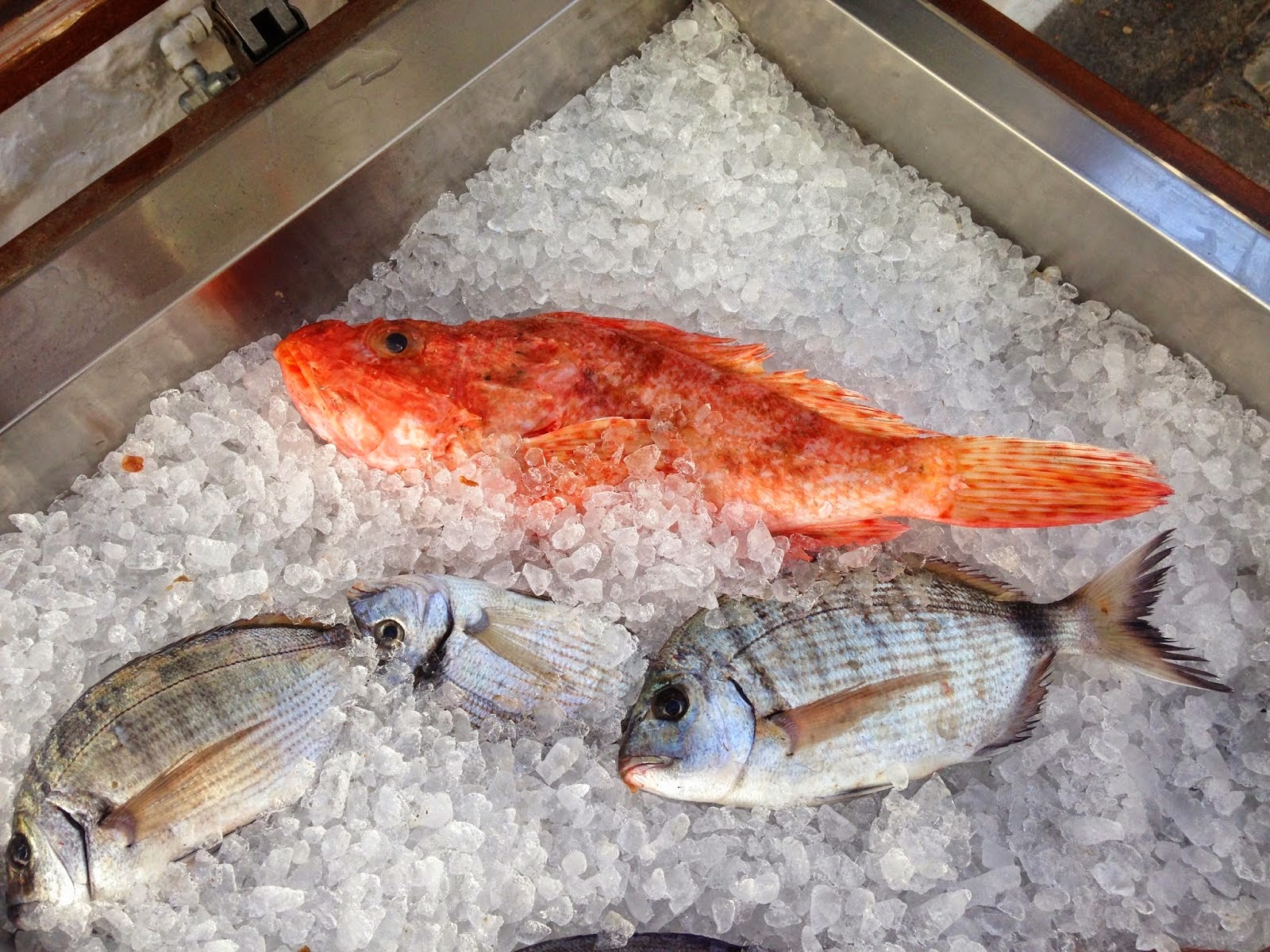
Does anyone know this red fish? Photo by Karla Hansen-Speer

We had our best meal during all of our travels on Hydra. We happened by a beautiful restaurant that had a lot of seating underneath a wisteria covered patio. We simply ordered Greek salad, some appetizers, and the asked for a fish to feed all of us.  The waiter recommend a fresh red fish that they had in their bin that would feed all of us (the one that we got was larger than the one in this picture). I think that the waiting said that it was carp which I was not too excited by, but it was an excellent white fish that was served with a tureen of melted butter. It tasted like lobster and melted in the mouth. After six months of traveling, this was the best meal that I had.


It seems that most coastal Greek towns had large covered patios outside of restaurants and cafes along the waterfront. As I mentioned before, we were traveling during the off-season which is a bit more cool and rainy than peak summer times (you can see us wearing our fleece jackets and the wind whipped flags in many of our photos). I could imagine that these patio areas are packed full during peak tourist season. Our visit to Hydra was also one of the highlights of our entire trip. The Greek Isles are a wonderful and beautiful place to visit. Their towns are picturesque and their windy streets make a stroll through town a wonderful adventure. The cooler temperatures and lack of crowds of the off-season suited me just fine. This would be a great place to return to for an extended stay in a place that embraces the allure of vacationing in the Greek Isles.


Thursday, June 19, 2014

Return to Athens


We had some friends come and visit us for a week at our house in Greece. Dr. Rob Morrissey completed his PhD at Purdue last year and his family moved to the Czech Republic in early spring for a post-doc in Prague in Dr. Miro Svoboda’s tree-ring lab (see a later post on this lab). Rob and Jen Miley have a girl (whom I will call E1) and a baby boy (whom I will call E2) that are very close to our kids’ ages (L1 and L2).  It was great to have them come and visit, which encouraged us to explore some more sites around Greece.  Our first trip was back to Athens to check out some new neighborhoods and to head back up the Acropolis.


One of the new things that I focused on this time was the Theater of Dionysus which is thought to have been the origin of Athenian theater. This site was first used in 500 BC and was later developed as a monument and theater to Dionysus. The full development of this theater is attested to the Athenian statesman Lycurgus (ca. 390-325 BC). 

 
The dark building behind the theater is the Acropolis Museum which was completed in 2009. This is a modern climate controlled museum that houses over 4,000 objects. Part of the motivation for the museum was to provide high quality display space for the Parthenon Marbles (also known as the Elgin Marbles). They were excavated and removed by Thomas Bruce, the 7th Earl of Elgin who had obtained a controversial permit from the Ottoman authorities. This was during his service as the British ambassador to the Ottoman Empire from 1799 to 1803. The British Parliament reviewed the case and decided that Elgin’s actions where just. At that time (1816) the British Government purchased the artifacts and installed them at the British Museum where they remain today, although the debate on whether the marbles should be returned to Greece is ongoing.


The Parthenon is always an amazing site to visit. As I mentioned in a previous post, the white stones are the newly quarried stones from the same quarry as the originals.  They should yellow to the color of the older stones over time. Much time and work is going into reconstructing the Parthenon, but the technical level of skill that went in to fitting the individual stones is amazing. Also, the dimensions of the Parthenon are interesting where the center of the span is a little bit higher than the ends to give the optical illusion of being straight. Much detail and expertise went into the original construction of the Parthenon so that the renovation of the building is a challenge to modern architects, engineers, and construction workers. Jen Miley is an architect so it was interesting to travel with her to get some more details on the construction of the buildings. We also had the opportunity to tour some of Athens sites with Dr. Nick Rauh who is a Professor of Classics from Purdue University. He is on sabbatical in Athens completing a book on the amphora of ancient Greece and analyzing them to better understand trade with other civilizations of the time.


The Juxtaposition of different time periods is always evident throughout Athens (and most of Greece). This is a ca 16th century church viewed through the entrance columns to the Roman Agora.


I always find the graffiti throughout Greece and every country that I visited to be interesting. Especially in Athens, it is often directly next to ancient architecture which creates an interesting mixture of the old and new.