I had the
opportunity to visit the University of Padua Dendrochronology Laboratory which
is run by Dr. Marco Carrer, for a few days at the end of my Northern Italy
tour. Dr. Daniele Castagneri was my gracious host and tour guide. Daniele and I
had met at the WorldDendro post-conference tour in New Zealand back in January
so it was good to see him again. Although seeing Daniele in his home territory
made me start to think about how I had been gone from my home for about four
months at this point. Daniele met me at the train station and took me to my accommodations.
Over a three day period, he showed me around the University of Padua lab, took
me up to the Eastern Italian Alps (see a later post on that), gave me a tour of
the Study Centre on the Alpine Environment (C.S.A.I.), and brought me to Venice
for a wonderful evening before my flight back to Greece early the next morning.
University
of Padua Dendrochronology Laboratory
Dr.
Marco Carrer
(Assistant Professor, Specialties: Dendrochronology - Forest Dynamics - Climate
Change)
Dr.
Tommaso Anfodillo
(Professor of Forest Ecology, Specialties: Water Relations in Forestry Species
- Forest Dynamics - Hydraulic Architecture)
Dr.
Gaia Petit
(Assistant Professor, Specialties: Ecology)
Dr.
Emanuele Lingua
(Assistant Professor, Specialties: Forest ecology)
Dr.
Daniele Castagneri
(Post doc, Specialties: Dendroecology - Wood Anatomy)
Study
Centre on the Alpine Environment
Raffaella
Dibona
Measurements and data collecting in forest - dendrochronological analysis
Roberto
Menardi Fields
activities - dendrochronological measurements - Trephor tool
 |
| Dr. Daniele Castagneri and Dr. Marco Carrer in Venice. |
The
dendrochronology laboratory is headed up by Dr. Marco Carrer who specializes in
dendroclimatology and dendroecology. He has examined Larix decidua, Abies alba, and Pinus
cembra for climate response (Carrer and Urbinati 2004, Carrer and Urbinati
2006, Carrer et al. 2007, Carrer et al. 2010) and has examined high-elevation
tree response to global warming (Career et al. 1998, Carrer and Urbinati 2001).
Dr. Carrer was invited to a workshop at
the WSL in Switzerland to collaborate on the Old World Drought Atlas with Dr.
Ed Cook and others, so he was not able to meet with me at the lab. He was kind
enough to rush back to Venice at the end of that workshop so that I could meet
with him in Venice on my last night. Dr. Carrer had relatives in Venice as he was
growing up, so he spent much time in the city. It was great to have a tour of
Venice from some locals and to spend a pleasant meal and evening talking with
Marco and Dr. Giai Petit who was also a resident of Venice and affiliated with
the University of Padua Dendrochronology Laboratory.

I met with Dr.
Tommaso Anfodillo at the University of Padua who works very closely with Dr.
Marco Carrer for climate response and with Dr. Giai Petit on wood anatomy of
tree rings. These three researchers have been examining wood anatomy in trees
(specifically on vessel size in angiosperms as well as xylem conduits in
conifers) for many years and have been able to demonstrate that vessel area can
be a function of climatic parameters although tree height needs to be
normalized out of the equation for accurate measurement other parameters (Anfodillo
et al. 1998, Anfodillo et al. 2002, Anfodillo et al. 2006, Petit et al. 2008, Petit and Anfodillo 2009, Petit et al. 2010, Petit et al.
2011, Anfodillo et al. 2012, Olson et al. 2014, Petit et al. 2014). I was very excited to hear about their work and use
of the program WinCell (part of the WinDendro package by Regent Instruments
Inc.) to quantify vessel area per ring. I would like to apply their methods to
examine disturbance ecology in trees (specifically with periodical cicada
outbreaks, fire, and defoliating insects), but tree height is a very important
determination of vessel size and currently I don’t systematically collect tree
height as I sample for disturbance ecology.
This is another piece of information that I will need to collect in the
future if I want to start to explore wood anatomy as another indicator of
disturbance events. I think this technique would be especially useful to
examine how periodical cicadas may be affecting the water use efficiency in
hardwood trees in the eastern United States during their nymphal stages
underground as they act as a root parasite to these trees and drain water and
nutrients form the trees.
 Dr. Daniele Castagneri
is a post doc in the Dendrochronology lab who specializes in dendroecology and works with
wood anatomy as well. I was excited to hear about his work with coarse woody
debris (Castagneri et al. 2010a) since
I had a masters student (Ross Alexander) who recently completed a MS Thesis on
the subject for the Eastern Deciduous Forest. Dr. Castagneri also works with
stand structure, ecological factors, and climate response with Picea abies (Norway Spruce) in sites in
Italy (Castagneri et al. 2008, Castagneri
et al. 2010b, Castagneri et al. 2012) as well as Norway
(Castagneri et al. 2013).
Dr. Daniele Castagneri
is a post doc in the Dendrochronology lab who specializes in dendroecology and works with
wood anatomy as well. I was excited to hear about his work with coarse woody
debris (Castagneri et al. 2010a) since
I had a masters student (Ross Alexander) who recently completed a MS Thesis on
the subject for the Eastern Deciduous Forest. Dr. Castagneri also works with
stand structure, ecological factors, and climate response with Picea abies (Norway Spruce) in sites in
Italy (Castagneri et al. 2008, Castagneri
et al. 2010b, Castagneri et al. 2012) as well as Norway
(Castagneri et al. 2013).
Dr. Emanuele Lingua works in the Ecology Group at the University of Padua although I had the opportunity to meet him while I
was visiting Dr. Renzo Motta at the University of Turin. Dr. Lingua focuses on
forest ecology and specifically has studied stand structure along an
elevational gradient in the Italian Alps (Lingua et al. 2008).
The University of
Padua Dendrochronology Laboratory was similar to many of the
dendrochronology labs that I have toured throughout Europe, Canada, and the
United States. They had a room dedicated to sample storage for cross sections
and cores.
They used a variety
of measuring machines (the greatest variety that I have seen) which included
Velmex (at the field station) and Aniol (an older measuring system) at the
University. I do not recall seeing any LinTab measuring systems which are the
European standard and developed by RinnTech.
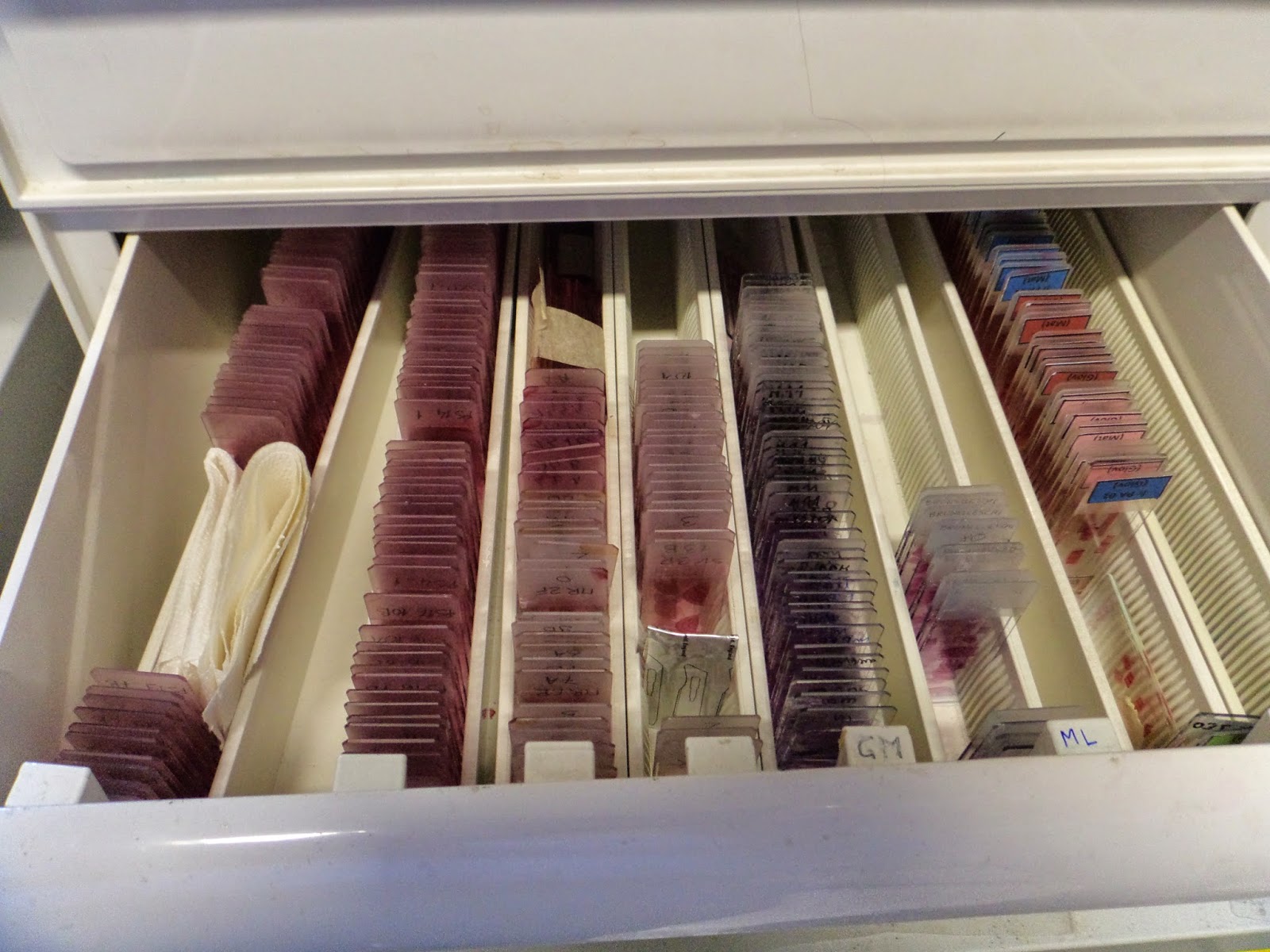
They use a rotary
microtome by Leica RM2145 for their wood anatomy slide preparation.
They have a very nice camera imaging system connected to a slide microscope to capture the data from their wood anatomy slides.
Because I organize
the North American Dendroecological Fieldweek (NADEF), I am always excited to
see a good field station that is equipped to handle large groups for field
studies and include lodging. The University of Padua has the Study Centre on
the Alpine Environment which is located in San Vito di Cadore in the Dolomite
Mountains in the Eastern Italian Alps near the town of San Vito.
The Study Centre on
the Alpine Environment was developed in 1962 and has a meteorological station,
bunk rooms, lecture hall, and laboratory rooms. The field station seemed to be
equipped to house about 20 people.
This was the first
time that I have seen a Velmex measuring stage in Europe (as most use the
LINTAB system). They also had pictures of the Bristlecone pine trees on their
walls which made me feel at home.
Along the
stairwell, they had soil monoliths which are a soil profile cut out and
preserved for study along with the requisite charismatic cross sections.
 |
| Roberto
Menardi locking up the xiloteque collection in its protective glass case. |
 They have an
antique xiloteque which is a library of books about tree identification where
the actual books are made out of the tree species showing the radial, cross
section, and transverse section of the wood, the bark, and the interior has
leaves, seeds, and other parts of the plant for identification. These where created
in the 19th century and consists of 56 species/books. Many where
lost or destroyed in the intervening years, but these pieces where saved and
are preserved in a glass case. They are truly amazing examples of craftsmanship
as well as useful guides for tree identification.
They have an
antique xiloteque which is a library of books about tree identification where
the actual books are made out of the tree species showing the radial, cross
section, and transverse section of the wood, the bark, and the interior has
leaves, seeds, and other parts of the plant for identification. These where created
in the 19th century and consists of 56 species/books. Many where
lost or destroyed in the intervening years, but these pieces where saved and
are preserved in a glass case. They are truly amazing examples of craftsmanship
as well as useful guides for tree identification.
They also had
historical sketches of the root systems of a variety of local trees which were
really well done and a great way to understand the below ground function of
these trees.
The Trephor
microcorer was developed at the University of Padua and the Study Centre on the
Alpine Environment. This is a great tool that is used to take shallow small
diameter plugs (15 mm in length and 2 mm in diameter) of wood for repeat
sampling of phenology work that examines the weekly growth of cells throughout
the season. This sampler is placed on the bark of the tree (which can be shaved
down if the bark is particularly thick) and hammered into the tree. Then the tool is pulled out of the tree and
the core can be stored in a plastic ampule container with a solution to keep it
moist and free of fungus.
References
Anfodillo, T., Carraro, V.,
Carrer, M., Fior, C., & Rossi, S. (2006). Convergent tapering of xylem
conduits in different woody species. New Phytologist, 169(2), 279-290.
Anfodillo, T., Deslauriers, A.,
Menardi, R., Tedoldi, L., Petit, G., & Rossi, S. (2012). Widening of xylem
conduits in a conifer tree depends on the longer time of cell expansion
downwards along the stem. Journal of experimental botany, 63(2), 837-845.
Anfodillo, T., Di Bisceglie, D.
P., & Urso, T. (2002). Minimum cuticular conductance and cuticle features
of Picea abies and Pinus cembra needles along an altitudinal gradient in the
Dolomites (NE Italian Alps). Tree physiology, 22(7), 479-487.
Anfodillo, T., Rento, S.,
Carraro, V., Furlanetto, L., Urbinati, C., & Carrer, M. (1998). Tree water
relations and climatic variations at the alpine timberline: seasonal changes of
sap flux and xylem water potential in Larix decidua Miller, Picea abies (L.)
Karst. and Pinus cembra L. In Annales des sciences forestières (Vol. 55, No.
1-2, pp. 159-172). EDP Sciences.
Carrer, M., Anfodillo, T.,
Urbinati, C., & Carraro, V. (1998). High-altitude forest sensitivity to
global warming: results from long-term and short-term analyses in the Eastern
Italian Alps. In The impacts of climate variability on Forests (pp. 171-189).
Springer Berlin Heidelberg.
Carrer, M., Nola, P., Eduard, J.
L., Motta, R., & Urbinati, C. (2007). Regional variability of
climate–growth relationships in Pinus cembra high elevation forests in the
Alps. Journal of Ecology, 95(5), 1072-1083.
Carrer, M., Nola, P., Motta, R.,
& Urbinati, C. (2010). Contrasting tree‐ring growth to climate responses
of Abies alba toward the southern limit of its distribution area. Oikos,
119(9), 1515-1525.
Carrer, M., & Urbinati, C.
(2001). Spatial analysis of structural and tree‐ring related parameters in a
timberline forest in the Italian Alps. Journal of Vegetation Science, 12(5),
643-652.
Carrer, M., & Urbinati, C.
(2004). Age-dependent tree-ring growth responses to climate in Larix decidua
and Pinus cembra. Ecology, 85(3), 730-740.
Carrer, M., & Urbinati, C.
(2006). Long‐term
change in the sensitivity of tree‐ring
growth to climate forcing in Larix decidua. New Phytologist, 170(4), 861-872.
Castagneri, D., Garbarino, M.,
Berretti, R., & Motta, R. (2010a). Site and stand effects on coarse woody
debris in montane mixed forests of Eastern Italian Alps. Forest ecology and
management, 260(9), 1592-1598.
Castagneri, D., Lingua, E.,
Vacchiano, G., Nola, P., & Motta, R. (2010b). Diachronic analysis of
individual-tree mortality in a Norway spruce stand in the eastern Italian Alps.
Annals of forest science, 67(3), 304.
Castagneri, D., Nola, P.,
Cherubini, P., & Motta, R. (2012). Temporal variability of size–growth
relationships in a Norway spruce forest: the influences of stand structure,
logging, and climate. Canadian Journal of Forest Research, 42(3), 550-560.
Castagneri, D., Storaunet, K. O.,
& Rolstad, J. (2013). Age and growth patterns of old Norway spruce trees in
Trillemarka forest, Norway. Scandinavian Journal of Forest Research, 28(3),
232-240.
Castagneri, D., Vacchiano, G.,
Lingua, E., & Motta, R. (2008). Analysis of intraspecific competition in two
subalpine Norway spruce (Picea abie (L.) Karst.) stands in Paneveggio (Trento,
Italy). Forest Ecology and Management, 255(3), 651-659.
Lingua, E., Cherubini, P., Motta,
R., & Nola, P. (2008). Spatial structure along an altitudinal gradient in
the Italian central Alps suggests competition and facilitation among coniferous
species. Journal of Vegetation Science, 19(3), 425-436.
Olson, M. E., Anfodillo, T.,
Rosell, J. A., Petit, G., Crivellaro, A., Isnard, S., ... & Castorena, M.
(2014). Universal hydraulics of the flowering plants: vessel diameter scales
with stem length across angiosperm lineages, habits and climates. Ecology
letters.
Petit, G., & Anfodillo, T.
(2009). Plant physiology in theory and practice: an analysis of the WBE model
for vascular plants. Journal of Theoretical Biology, 259(1), 1-4.
Petit, G., Anfodillo, T.,
Carraro, V., Grani, F., & Carrer, M. (2011). Hydraulic constraints limit
height growth in trees at high altitude. New Phytologist, 189(1), 241-252.
Petit, G., Anfodillo, T., &
Mencuccini, M. (2008). Tapering of xylem conduits and hydraulic limitations in
sycamore (Acer pseudoplatanus) trees. New Phytologist, 177(3), 653-664.
Petit, G., DeClerck, F. A.,
Carrer, M., & Anfodillo, T. (2014). Axial vessel widening in arborescent
monocots. Tree physiology, tpt118.
Petit, G., Pfautsch, S.,
Anfodillo, T., & Adams, M. A. (2010). The challenge of tree height in
Eucalyptus regnans: when xylem tapering overcomes hydraulic resistance. New
Phytologist, 187(4), 1146-1153.
Rossi, S., Anfodillo, T., &
Menardi, R. (2006). Trephor: a new tool for sampling microcores from tree
stems. Iawa Journal, 27(1), 89.